Every IT operations team knows the 2 a.m. feeling. A service starts degrading. An alert fires — then twenty more. The on-call engineer opens one console to check infrastructure, another for logs, a third for the CMDB, a fourth for recent changes. Twenty minutes pass before anyone even understands what is broken, let alone why. And the only person who can actually run the root-cause analysis is the senior engineer who is, of course, asleep.

This is the daily reality of modern ITOps: not a shortage of data, but a flood of it — scattered across dashboards, disconnected from context, and dependent on a handful of experts to interpret. The tooling tells you what happened. It rarely helps you act.

LUMI was built to close that gap.

What LUMI Actually Is

LUMI is an ITOps copilot — a conversational AI that sits across your entire hybrid and multicloud environment and lets you run operations through natural language instead of a wall of dashboards. It ingests real-time data from your whole stack — infrastructure, cloud, applications, cost, compliance, and sustainability signals — and acts as an intelligent layer that monitors, reasons, decides, and acts.
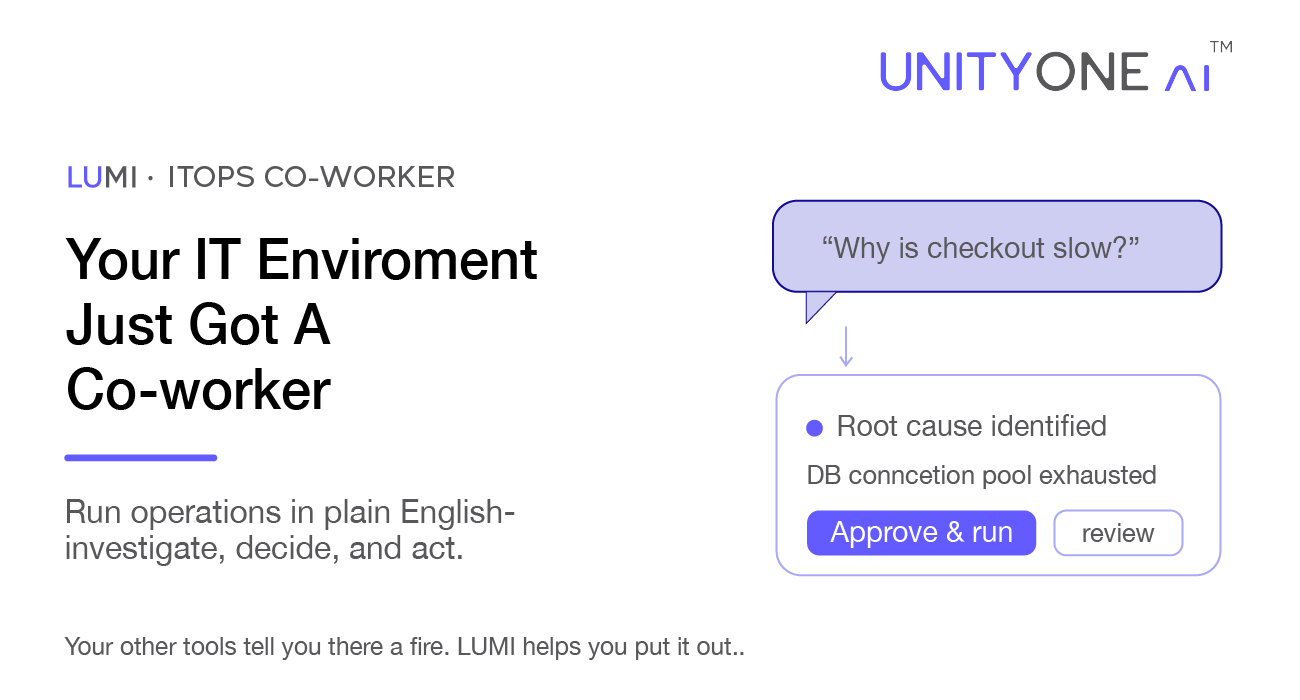
The important word there is acts. LUMI is not another observability dashboard and not a generic chatbot bolted onto your monitoring. It’s a copilot that can investigate an incident, build a resolution plan, recommend the exact fix, and execute it — either with your approval or autonomously, according to the guardrails you set.
Put simply: your other tools tell you there’s a fire. LUMI helps you put it out.

Where LUMI Optimizes ITOps

1. From dashboards to plain-English answers

Most operational knowledge is locked behind expertise. You need to know which dashboard to open, which query to write, which console holds the answer. LUMI removes that barrier. Ask it in plain English — “Which hosts are running hot right now?”, “What changed on the payment service in the last 24 hours?”, “Show me our cloud spend anomalies this week” — and get a context-aware answer in seconds.
The result is a team that no longer depends on a few specialists to extract insight. A junior engineer with a good question is suddenly as effective as a senior one with a dozen dashboards open.

2. Faster incident resolution, lower MTTR

Most operational knowledge is locked behind expertise. You need to know which dashboard to open, which query to write, which console holds the answer. LUMI removes that barrier. Ask it in plain English — “Which hosts are running hot right now?”, “What changed on the payment service in the last 24 hours?”, “Show me our cloud spend anomalies this week” — and get a context-aware answer in seconds.
This is where the operational math gets compelling. Teams adopting this kind of AI-driven, closed-loop resolution report dramatically faster mean-time-to-resolution and a sharp drop in the manual toil that consumes on-call hours. Fewer bridge calls. Fewer escalations. Fewer 2 a.m. wake-ups.

3. Root cause in one step, not one afternoon

Root-cause analysis is traditionally the most expensive part of an incident — hours of correlating logs, chasing dependencies, and reconstructing what changed. LUMI generates instant RCA summaries with contextual diagnosis, change-impact analysis, and historical pattern matching across the entire stack. What used to take an afternoon of a senior engineer’s time becomes a summary you can read and act on.

4. Automation that fits your risk appetite

When anomalies hit — a CPU spike, a memory leak, network degradation — LUMI can detect the pattern and run a remediation workflow. Crucially, you decide how much autonomy it has. Start with confirmation-based execution, where LUMI proposes and a human approves. Graduate to fully autonomous remediation for the routine, well-understood cases once you trust it. Autonomy is a dial you control, not a switch someone else flips.

5. Specialized agents, built without code

Beyond answering questions, LUMI lets you build domain-specific AI agents with no code — for VMware, databases, Kubernetes, FinOps, security, and more. Each agent gets its own tools, memory, and execution logic, and can be triggered by chat, a schedule, a webhook, or an ITSM event. Instead of one generic assistant, you get a team of specialists, each tuned to a part of your estate.

How It Works: Prompt to Resolution in Four Steps

LUMI combines a private LLM, a unified data model across your platforms, and an agentic execution engine to close the loop from detection to resolution:
Query and identify. Interact in natural language. Ask LUMI to surface an anomaly or investigate an issue across your environment.
Build context. LUMI pulls live telemetry, logs, topology, and infrastructure dependencies from your connected systems.
Reason and recommend. It analyzes the operational context, identifies the root cause, and generates a remediation plan.
Execute and resolve. It runs the workflow — autonomously or with approval — and updates your ITSM systems automatically.

Built for Enterprise Trust

The single biggest hesitation teams have about AI in operations is understandable: Do I really want AI touching production? LUMI is designed for exactly that concern.
Every action can pass through human-in-the-loop approval gates. Access is governed by role-based controls. Every recommendation and action is captured in a full audit trail. And because LUMI runs on a private LLM grounded in your own operational data, your information never leaves your environment and its answers are anchored in real telemetry rather than guesswork. It’s AI you can put in front of an auditor.

Why This Matters Now

IT estates have never been more complex — hybrid, multicloud, containerized, and sprawling across dozens of tools. Hiring your way out of that complexity isn’t realistic, and asking engineers to do more manual correlation isn’t sustainable. The teams that win are the ones that put an intelligent layer on top of the mess: one that understands cause, risk, and next-best-action, and that can act.
That’s the promise of an ITOps copilot. Not another screen to watch, but a partner that watches for you — and helps you resolve issues before they become outages.

See LUMI for Yourself

LUMI is best understood by using it. Try it against sample data in a live sandbox, ask it real operational questions, trigger a runbook, and watch it investigate an incident end to end. The difference between reading about a copilot and prompting one is the difference between a slide and a solution.
Your IT environment just got a co-pilot. Just prompt.
Ready to see how LUMI can optimize your ITOps? Request a demo or start a free trial today.

Ready to get started? 

Need to know our custom pricing or get a free demo? Click on the link below to connect with us.  

Technical Support

Available 24/7 to assist you with your queries.

Careers

Ready to take your career to the cloud?

About UnityOne AI

UnityOne AI™ is an agentic intelligence platform for ITOps management, comprising CERNE, LUMI, and VEKTOR. CERNE replaces dozens of cloud management tools by unifying DCIM, AIOps, HCMP, FinOps, and GreenOps within a single AI-driven control plane. LUMI, the AI copilot, provides contextual intelligence, operational recommendations, and workflow automation, while VEKTOR enables enterprises to provision, orchestrate, and scale AI factories with the lowest cost-to-serve. The UnityOne AI™ suite enables enterprises to simplify hybrid/multicloud operations, strengthen governance, optimize resource utilization, and accelerate transformation to AI-driven ITOps.

Solutions

cerne

Products

Observability

About Us

Company

Copyright © 2026 • All Rights Reserved