Building an AI factory is one of the hardest infrastructure problems an organization can take on today. GPUs are scarce and expensive. Utilization is notoriously hard to keep high. The economics of running your own inference versus renting a public API are murky at best. And once the hardware is racked, someone still has to turn it into a governed, multi-tenant service that people can actually consume safely.
Most teams end up assembling this from a dozen disconnected tools — one for GPU monitoring, another for scheduling, a spreadsheet for cost, a patchwork of scripts for tenant onboarding. The result is slow to stand up and painful to operate.
VEKTOR exists to change that. It’s the operating system for your AI factory: a single platform to provision GPU infrastructure, govern token economics, orchestrate workloads, and deliver AI services at scale — set up in stages, run from one console.

The Two Problems VEKTOR Solves

Every AI factory initiative runs into the same two walls.
The first is speed. Getting from “we bought GPUs” to “we’re serving production AI workloads to tenants with SLAs and billing” can take months of integration work. Every day those GPUs sit underused is money burning.
The second is control. Once you’re live, keeping the factory efficient, profitable, and compliant is a continuous grind. What’s my real cost per million tokens? Which racks are idle? Is this tenant within their allocation? Should this workload run on my hardware or a public API? Without a unified view, these questions go unanswered — and margins quietly leak away.
VEKTOR is built around both: a structured delivery model that gets you live faster, and a unified operations layer that keeps you in control afterward.

Where LUMI Optimizes ITOps

VEKTOR structures AI factory delivery into four clear phases, so you’re never staring at a blank slate wondering what comes next.
Design. Before a single workload runs, you plan your GPU fleet topology, define your tenant architecture, configure switch fabric, and establish your service catalog and token pricing model. You’re designing the factory deliberately instead of discovering its shape by accident.
Build. You deploy and configure the full infrastructure stack, onboard tenants, activate workload pipelines, connect your public and private LLM APIs, and validate that token flows work end to end. The build phase turns the design into a running system.
Operate. You run the factory in production — monitoring GPU health, managing token throughput, tracking revenue, optimizing workloads, and enforcing governance at scale.
Handover. For providers and integrators, VEKTOR delivers a production-ready factory to the client team with full documentation, training, audit trails, and self-service capabilities — so they walk away with complete operational autonomy.
The value of this model is that it compresses a sprawling, ambiguous project into a repeatable sequence. Whether you’re an enterprise standing up an internal factory or an integrator delivering one for a client, you follow the same proven path — and you get there faster because the platform already knows the steps.

Run It Better: Unified AI Factory Operations

Standing the factory up is only half the story. VEKTOR’s real payoff is in day-to-day operations, where it replaces the patchwork with one control plane.

Full-stack GPU fleet management

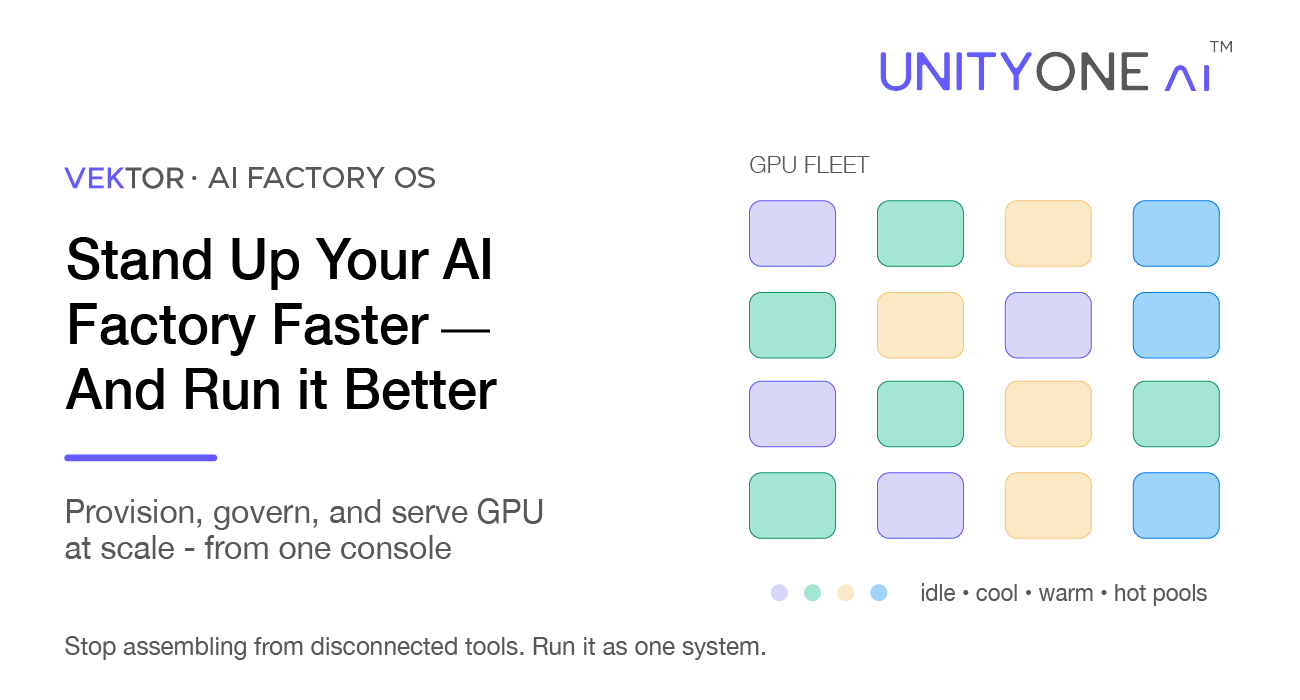
Provision, monitor, and optimize GPU clusters from a single console. VEKTOR gives you real-time visibility into GPU utilization, thermal state, and power draw per rack, and lets you discover and visualize rack topology, switch fabric, and node inventory. You can plan capacity across idle, cool, warm, and hot GPU pools — so expensive silicon isn’t sitting dark while demand waits elsewhere.

Token economics and true cost-to-serve

This is where VEKTOR is genuinely different. It tracks token usage across every workload and LLM API and computes your exact cost-to-serve per million tokens — factoring in GPU power, data-center efficiency (PUE), and networking costs. Then it benchmarks your private inference economics against public API spend. The result is that workload placement stops being a guess: you can see, in real numbers, whether a given job belongs on your own hardware or a public endpoint.

Token economics and true cost-to-serve

This is where VEKTOR is genuinely different. It tracks token usage across every workload and LLM API and computes your exact cost-to-serve per million tokens — factoring in GPU power, data-center efficiency (PUE), and networking costs. Then it benchmarks your private inference economics against public API spend. The result is that workload placement stops being a guess: you can see, in real numbers, whether a given job belongs on your own hardware or a public endpoint.

Multi-tenancy and workload delivery

VEKTOR runs fully isolated multi-tenant GPU environments with self-service portals, dedicated allocations, and role-based access. It schedules AI workloads across GPU pools based on SLA, cost-to-serve, and available capacity, and gives every tenant a metered dashboard showing consumption, cost, and workload-level economics. That metering is what makes it possible to run the factory as a real commercial service — or to charge back accurately across internal business units.

LLM orchestration and portability

Route inference requests across engines like vLLM, LiteLLM, TensorRT-LLM, and public APIs, and migrate workloads between private and public LLMs without re-engineering. With support for PyTorch, TensorFlow, ONNX, and CUDA across distributed, multi-cluster infrastructure, your factory stays flexible and cost-efficient as models and providers change.

Governance, compliance, and security

Enforce RBAC, SSO, and MFA with per-tenant policies. Maintain full audit logs, compliance dashboards, and exportable configurations. And secure workload execution with hardware-backed confidential computing — so the factory is enterprise-ready and auditable from day one.

Operate it by conversation

Because VEKTOR integrates with the LUMI copilot, you can run the factory through natural language. Ask about fleet health, underperforming racks, or idle GPUs; trigger runbooks, rollouts, and rollbacks through approval-gated actions. The copilot sees the full operator and tenant workspace and executes policy-driven actions — so operations become a conversation, not a scavenger hunt across consoles.

Who VEKTOR Is Built For

VEKTOR fits three kinds of teams:
GPU cloud providers who want to deliver GPU-as-a-service at enterprise scale — managing the fleet, onboarding tenants, setting pricing, tracking revenue, and delivering SLA-backed compute from one operator console.
Enterprise AI teams running private AI factories internally, who need commercial-grade rigor — full tokenomics, workload governance, and hybrid LLM spend management across business units.
Integrators and MSPs who build, manage, and hand over production-ready AI factories, with audit trails, self-service tooling, and support hooks baked in from day one.

The Bottom Line

An AI factory is a serious investment, and the difference between a good one and a bad one comes down to two things: how fast you can make it productive, and how well you can control its economics once it is. VEKTOR designed for both — a staged delivery model that gets you to production faster, and a unified operations layer that keeps utilization high, costs transparent, and governance airtight.
Stop assembling your AI factory from disconnected tools. Run it as one system.
Ready to build your AI factory? Step into the VEKTOR operator console with sample data, or request a demo to see it against your own environment.

Ready to get started? 

Need to know our custom pricing or get a free demo? Click on the link below to connect with us.  

Technical Support

Available 24/7 to assist you with your queries.

Careers

Ready to take your career to the cloud?

About UnityOne AI

UnityOne AI™ is an agentic intelligence platform for ITOps management, comprising CERNE, LUMI, and VEKTOR. CERNE replaces dozens of cloud management tools by unifying DCIM, AIOps, HCMP, FinOps, and GreenOps within a single AI-driven control plane. LUMI, the AI copilot, provides contextual intelligence, operational recommendations, and workflow automation, while VEKTOR enables enterprises to provision, orchestrate, and scale AI factories with the lowest cost-to-serve. The UnityOne AI™ suite enables enterprises to simplify hybrid/multicloud operations, strengthen governance, optimize resource utilization, and accelerate transformation to AI-driven ITOps.

Solutions

cerne

Products

Observability

About Us

Company

Copyright © 2026 • All Rights Reserved