Ask any operations leader where their time and budget really go, and the answer is rarely “solving problems.” It’s context-switching between tools. A performance incident lives in one console, cloud spend in another, capacity planning in a third, compliance in a fourth. Each tool sees a slice of the truth, none sees the whole, and the humans in the middle spend their days translating between them.
This tool sprawl isn’t just annoying — it’s the root cause of slow incident resolution, wasted spend, blind spots, and burned-out teams. You can’t act intelligently on a system you can only see in fragments.
CERNE is built on a different premise: that ITOps, CloudOps, and InfraOps aren’t separate problems needing separate tools. They’re one problem — running your infrastructure well — viewed from different angles. Solve it on one intelligent platform, and everything downstream gets faster, cheaper, and clearer.

The Power of One: Five Domains, One Platform

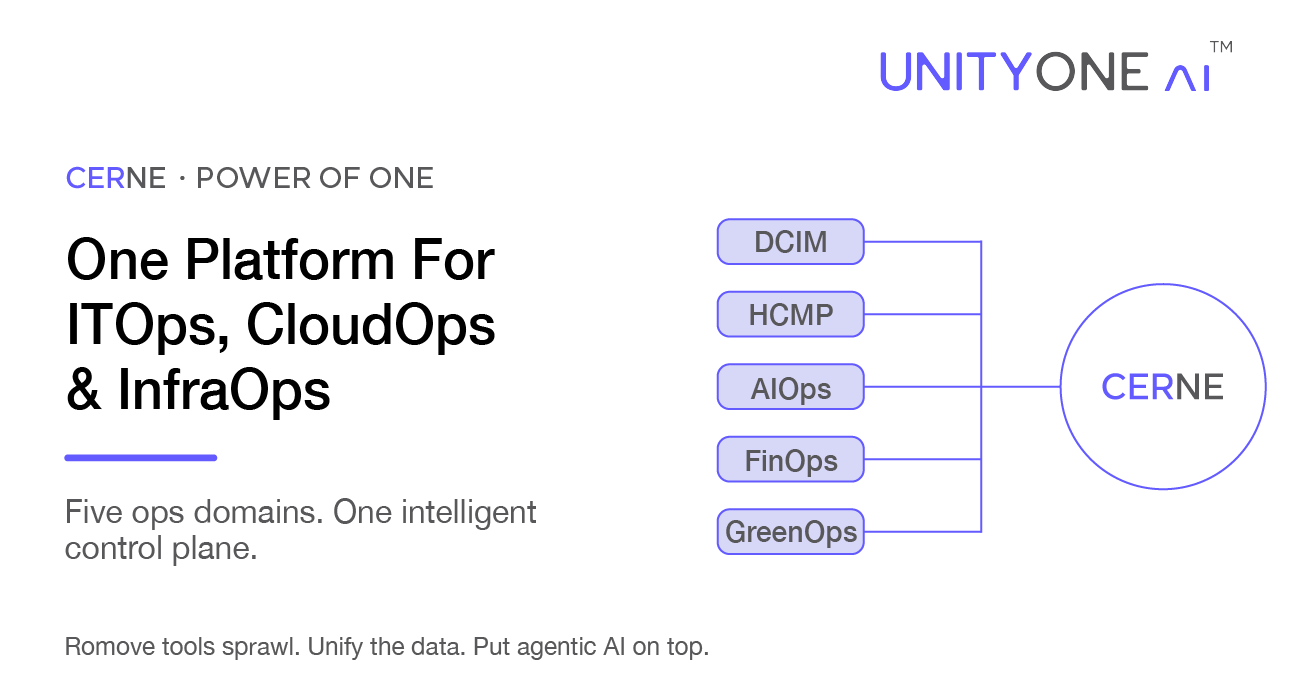
CERNE unifies five operational domains that most organizations run as separate products, into a single operating fabric. This is the “Power of One” — one place to manage your entire hybrid and multicloud estate, instead of a patchwork you have to stitch together yourself.
DCIM — your infrastructure foundation. Centralized visibility across power, space, capacity, and assets, with agentless discovery for distributed infrastructure. Intelligent capacity planning means you stop over-provisioning and start using what you already own — CERNE cites up to 70% lower CapEx as the payoff.
HCMP — your hybrid cloud control plane. Operate clouds, on-prem, and containers from one management plane with policy-driven automation. AI-orchestrated operations are cited as driving 50–60% lower OpEx.
Multicloud AIOps — your operations brain. Turn telemetry and events into intelligent action: faster detection, event correlation that cuts alert noise and fatigue, and AI-driven root-cause analysis with guided remediation.
FinOps — your cost discipline. Track consumption in real time, rightsize resources with AI, and align spend to business value through chargeback and showback. CERNE cites up to 30–40% less cloud resource waste.
GreenOps — your sustainability layer. Measure and optimize energy use across the estate, reducing footprint without sacrificing SLAs — cited at up to 50% lower footprint.
The point isn’t any single domain. It’s that they finally live together. A capacity decision (DCIM) informs a cost decision (FinOps) informs a sustainability outcome (GreenOps), and an incident (AIOps) can be understood in the full context of all three. That cross-domain visibility is impossible when every function sits in its own silo.

Whatever the Ops Problem, One Place to Solve It

Because CERNE spans the full breadth of operations, the same platform answers questions that would otherwise require three teams and five tools.
An InfraOps problem — “We’re running out of capacity in a data center and don’t know what to decommission.” CERNE’s unified asset and power visibility, plus intelligent capacity planning, turns that from a fire drill into a plan.
A CloudOps problem — “Our multicloud environment is a black box and costs are climbing.” One management plane with policy-driven automation and real-time cost tracking replaces the guesswork with control.
An ITOps problem — “An incident is cascading across services and nobody can find the root cause fast enough.” The AIOps engine correlates telemetry across the stack, suppresses noise, and drives guided remediation — with root-cause analysis that used to take an afternoon delivered in a summary.
Different problems, different teams, different vocabularies — but one platform underneath, drawing on one unified picture of your environment.

The Intelligence That Ties It Together

Consolidation gives CERNE breadth. Its agentic intelligence gives it depth. CERNE is structured as a layered system that moves from raw signal to reasoned action:
A data and context layer unifies telemetry, events, topology, CMDB, business context, and historical baselines — so the platform understands not just what is happening, but why it matters.
An intelligence and agentic AI layer analyzes those signals, detects patterns, predicts outcomes, and performs root-cause analysis and blast-radius prediction. It generates next-best-action recommendations and predictive alerts across performance, cost, and security — with confidence scoring so you know how much to trust each conclusion.
An automation layer closes the loop, connecting workflows, remediation, approvals, and ITSM processes so insight turns into action.
A security and governance layer protects all of it with identity management, tenant isolation, encryption, auditability, and policy enforcement.
An interaction layer — where the LUMI copilot lives — surfaces everything through dashboards, alerts, reports, and natural-language conversation, tailored to every persona on the team.
Crucially, this isn’t a single model answering questions. CERNE can orchestrate multiple specialized AI agents that collaboratively investigate an issue and drive it to resolution, governed by policy and human-in-the-loop approval. It’s the difference between a tool that tells you there’s a problem and a system that helps you fix it.
Why This Matters

The complexity of modern infrastructure — hybrid, multicloud, containerized, sprawling — isn’t going to shrink. Hiring more engineers to manually correlate across more tools doesn’t scale, and it doesn’t make anyone’s night on-call any better.
The organizations that get ahead are the ones that stop treating ITOps, CloudOps, and InfraOps as separate disciplines with separate tooling, and start running them as one intelligent, governed system. That’s the shift CERNE is built for: remove the tool sprawl, unify the data, put AI-driven reasoning and agentic action on top, and give every team one place to work.
Your infrastructure is ready for autonomy. Connect your cloud, on-prem systems, and ITSM tools into one operational layer — and start resolving issues from day one.
Want to see CERNE unify your operations? Explore it in a live sandbox or request a demo against your own environment.
A note on the figures above: the CapEx, OpEx, waste, and footprint percentages are CERNE’s stated potential outcomes. Actual results depend on your starting point and how much of your estate you bring onto the platform — worth framing as “up to” rather than guaranteed when you publish.

Ready to get started? 

Need to know our custom pricing or get a free demo? Click on the link below to connect with us.  

Technical Support

Available 24/7 to assist you with your queries.

Careers

Ready to take your career to the cloud?

About UnityOne AI

UnityOne AI™ is an agentic intelligence platform for ITOps management, comprising CERNE, LUMI, and VEKTOR. CERNE replaces dozens of cloud management tools by unifying DCIM, AIOps, HCMP, FinOps, and GreenOps within a single AI-driven control plane. LUMI, the AI copilot, provides contextual intelligence, operational recommendations, and workflow automation, while VEKTOR enables enterprises to provision, orchestrate, and scale AI factories with the lowest cost-to-serve. The UnityOne AI™ suite enables enterprises to simplify hybrid/multicloud operations, strengthen governance, optimize resource utilization, and accelerate transformation to AI-driven ITOps.

Solutions

cerne

Products

Observability

About Us

Company

Copyright © 2026 • All Rights Reserved