Service Level Management for.
Hybrid Cloud.

UnityOne AI turns the service level from a monthly report into a live control input
– projecting breach risk before the threshold is crossed and acting within your
guardrails while the error budget still holds.
The service model

One definition of service, from
CI to commitment

SLA definitions, OLAs, and underpinning contracts in one place — each
resolved to the configuration items that carry the service.
Unified commitment model
Availability, latency, response, and resolution targets defined once across DCIM, AIOps, HCMP, FinOps, and GreenOps – measured against one service definition, not four.
Live dependency map
Continuous discovery maps every service to its supporting CIs across hosts, clusters, network paths, databases, and application tiers – so impacted commitments are known at the moment of degradation.
Configuration accuracy
CMDB Sync maintains CI relationships, service ownership, and support group assignment – so SLA definitions attach to the right service and route to the right queue.
Agreement chain modeling
SLAs, team OLAs, and vendor underpinning contracts modeled as one chain with independent clocks – making internal handoff and third-party response time attributable.
Agentic service level defense

Step up from measuring commitments to acting on them

The same engine that measures your commitments can act on them — at whatever degree of autonomy you grant.
Error budget as trigger
Burn rate against the compliance window is evaluated continuously and functions as an execution trigger – not a month-end metric.
Stateful reasoning
Agents reason over unified telemetry, topology, CMDB, and incident state – so remediation reflects current conditions rather than a static runbook.
Deep graph memory
Current signals are linked to historical breach patterns, prior remediations, and change history – so each decision inherits what the estate has already learned.
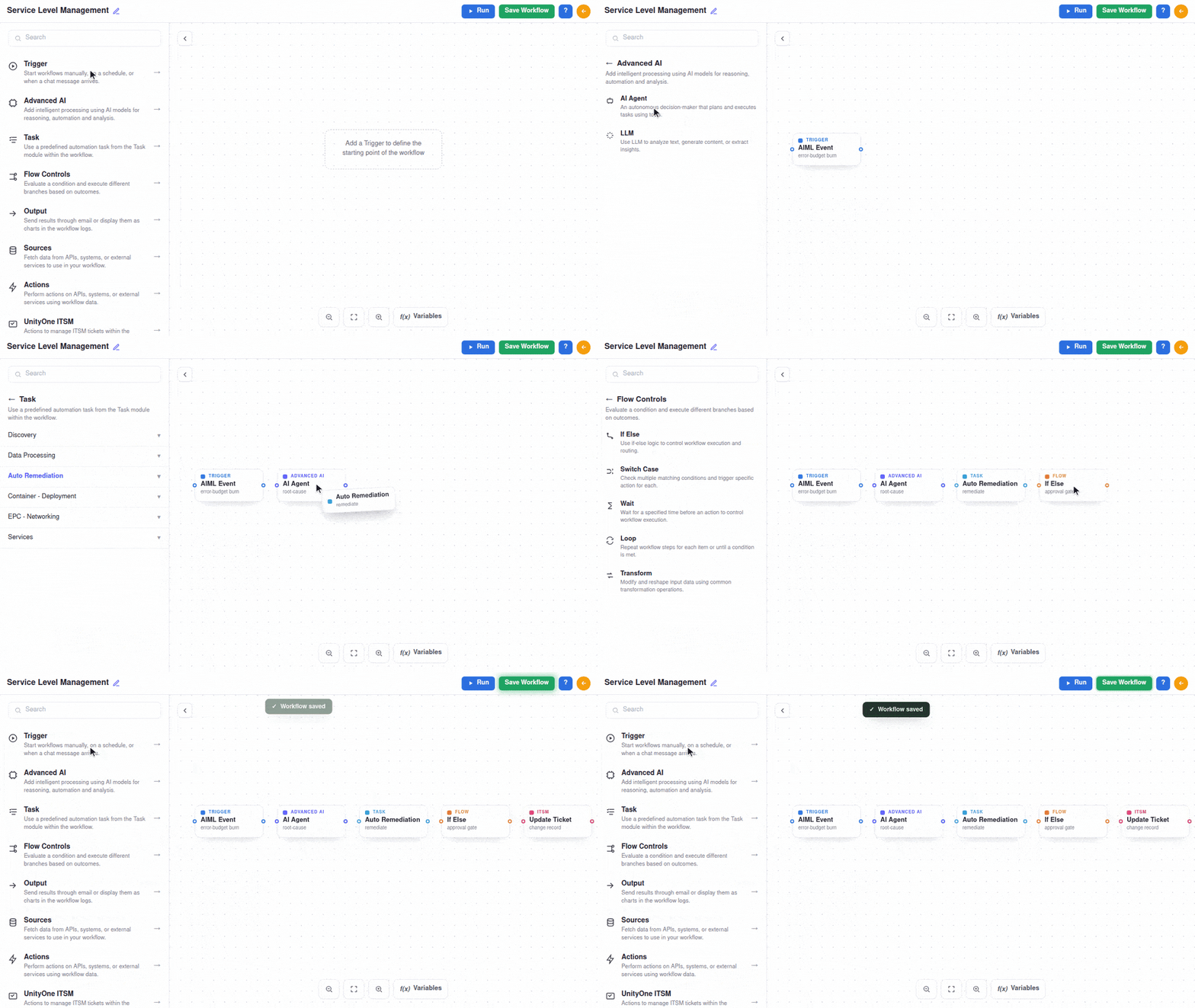
Agent Builder
Start from prebuilt agents for network, compute, database, and support workflows, then extend service level actions with no-code / low-code configuration.
Policy-bound autonomy
Scope, approval gates, and blast-radius limits govern every agent action, and every action is written to the change record – autonomy that holds up in an audit and a post-incident review.
Agentic service level defense
GenAI copilot

Ask what’s at risk, in plain language

GenAI sits over unified telemetry, topology, CMDB, incident, and change data — so service owners and duty managers can query commitment status directly.
GenAI copilot
How it works
Define, measure, project,
act
One engine takes the service level from a definition to continuous
protection — on your terms, at your pace.

1

Define
Model SLAs, OLAs, and underpinning contracts once, resolved to the CIs that carry each service.

2

Measure
Track availability, latency, response, and resolution against one live service definition and its dependency map.

3

Project
Evaluate error-budget burn across multiple windows to surface the path to breach while remediation is still possible.

4

Act
Remediate under policy with approval gates and blast-radius limits — every action written to the change record.
Why UnityOne AI
Fewer breaches, less
manual reporting, better
reliability decisions
Turn the service level into something you protect continuously — not
something you reconcile after the fact.
Breach prevention
Burn-rate projection surfaces at-risk SLAs and SLOs while remediation is still possible, then executes it under policy – fewer breaches, service credits, and escalations.
Lower L1/L2 volume
LUMI resolves the routine incident and request volume that consumes response and resolution targets – freeing engineers for the recurring causes behind repeat incidents.
Reporting without the manual pack
SLA attainment, response and resolution performance, and availability against target – generated from live data, with no monthly export and reconciliation cycle.
Attributable accountability
Dependency maps, change correlation, and action histories show where the target was missed – and which team, queue, or vendor held that link.
Cost-justified service tiers
Cost-to-serve mapped against each commitment tier – evidence to defend a target in budget review or retire one with no business value.
Consistent governance
The same SLA definitions, approval policies, and reporting standards across colocation, private cloud, and public cloud.
In practice
Service level management in
practice
Where continuous protection lands in day-to-day reliability work — from
breach avoidance to multi-tenant tiers.
Predictive
Predictive breach avoidance
Multi-window burn-rate evaluation flags the path to breach rather than the breach itself, traced to its contributing cause and remediated inside policy – with recovery validated before the threshold is reached.
Change Safety
Change-induced degradation
Deployments, patches, and configuration changes correlated against service level movement – identifying the responsible change during the incident.
Major Incident
Incident impact assessment
When a P1 opens, affected services, tenants, and active commitments are identified immediately – the bridge call starts with scope established.
OLA Enforcement
Internal handoff enforcement
OLA clocks tracked independently across network, platform, application, and support – triggering escalation before internal delay consumes the customer-facing target.
Capacity & Cost
Capacity and cost trade-offs
Headroom, utilization, and spend evaluated against each target – so scaling decisions are justified by the commitment they protect.
Multi-Tenant
Multi-tenant service tiers
Differentiated SLA and SLO models per tenant on one control plane – premium tiers without proportional delivery staff.
Continuous protection

Move from monthly
service reviews to
continuous protection

Ready to get started? 

Talk to an expert.

Technical Support

Available 24/7 to assist you with your queries.

Playground

Experience UnityOne AI in action.

About UnityOne AI ™

UnityOne AI™ is an agentic intelligence platform for ITOps management, comprising CERNE™, LUMI™, and VEKTOR™. CERNE™ replaces dozens of cloud management tools by unifying DCIM, AIOps, HCMP, FinOps, and GreenOps within a single AI-driven control plane. LUMI™, the AI copilot, provides contextual intelligence, operational recommendations, and workflow automation, while VEKTOR™ enables enterprises to provision, orchestrate, and scale AI factories with the lowest cost-to-serve. The UnityOne AI™ suite enables enterprises to simplify hybrid/multicloud operations, strengthen governance, optimize resource utilization, and accelerate transformation to AI-driven ITOps.