ai-powered-shared_compact new

The landscape has gotten brutally complex

Global System Integrators have never operated in a more demanding environment. The promise of cloud was simplification. What most GSIs have ended up with is the opposite: a sprawling, multi-layered operational estate spanning private data centers, multiple public clouds, hundreds of enterprise customers, and a monitoring toolchain that looks less like a control plane and more like a patchwork quilt.
A mid-size GSI today might manage infrastructure across VMware vCenter, Nutanix, Azure, AWS, Google Cloud, and Oracle Cloud simultaneously, each with its own telemetry format, alert schema, and operational dashboard. Add in ServiceNow for service management, Okta or Entra ID for identity, OpenTelemetry-instrumented applications, and real user monitoring feeds, and the operational picture becomes genuinely difficult to hold together.
The consequences are predictable. Alert fatigue sets in. NOC, cloud ops, and application teams operate in silos, each seeing their slice of the estate but none seeing the whole. When an incident strikes, root cause analysis becomes a triage exercise across six dashboards instead of a decisive diagnostic conversation. And the enterprise customers on the other end see delays, missed SLAs, and opaque status pages.
This isn’t a tooling problem that more tooling will solve. It’s a fundamental architecture problem.

What a Shared Services Platform is supposed to do, and why it falls short

The aspiration behind a Shared Services Platform is sound. A single operating model that lets a GSI serve dozens of enterprise customers with consistent quality, automated provisioning, full cost transparency, and real-time operational visibility, that is the goal.
The typical architecture begins well. ServiceNow provides the service catalog and CMDB backbone. Customers request virtual machines, Kubernetes clusters, database environments, or application hosting, and every provisioned asset becomes a record in the system of record. Identity is handled cleanly through enterprise SSO. Infrastructure provisioning flows into private and public cloud environments that are auto-discovered and monitored.
But here is where it starts to come apart.
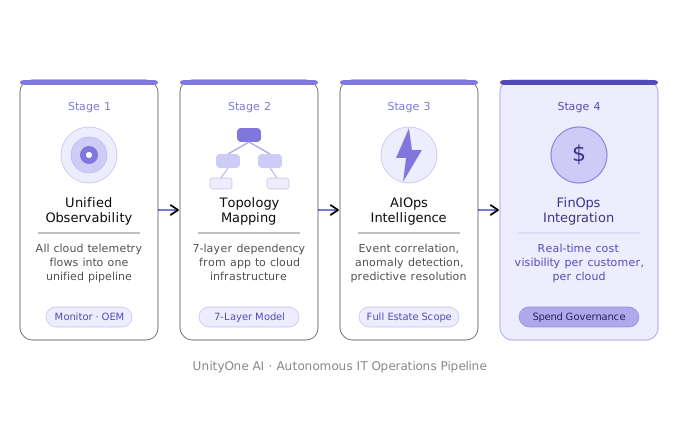
Stage 1
Unified Observability
All cloud telemetry, Azure Monitor, CloudWatch, GCP Monitoring, OEM, on-prem — flows into one pipeline
Stage 2
Topology Mapping
7-layer dependency model from business application down to cloud or data center infrastructure
Stage 3
AIOps Intelligence
Event correlation, anomaly detection, and predictive incident resolution across the entire estate
Stage 4
FinOps Integration
Real-time cost visibility per customer, per cloud, with continuous optimization and spend governance
Each stage builds on the last. Visibility without topology is noise. Topology without AI is a map without a compass. And AI-driven operations without cost intelligence leaves a critical dimension of the estate unmanaged.

Why UnityOne AI?

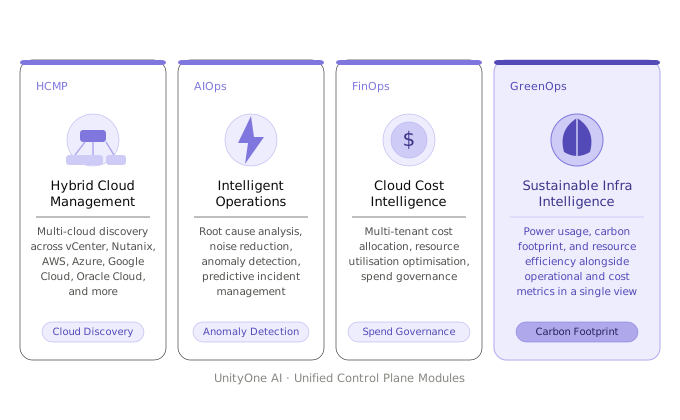
UnityOne AI is built for exactly this architecture. It functions as the single control plane across the entire Shared Services Platform, not as a layer added on top, but as the operational centre the platform is organised around.
HCMP
Hybrid Cloud Management
Multi-cloud discovery across vCenter, Nutanix, AWS, Azure, Google Cloud, Oracle Cloud, and more.
AIOps
Intelligent
Operations
Root cause analysis, noise reduction, anomaly detection, predictive incident management
FinOps
Cloud Cost
Intelligence
Multi-tenant cost allocation, resource utilisation optimisation, spend governance
GreenOps
Sustainable Infra Intelligence
Power usage, carbon footprint, and resource efficiency sit alongside operational and cost metrics in a single view.
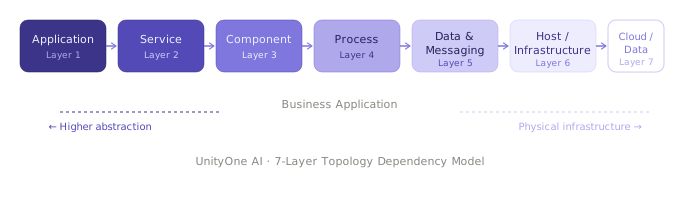
Complete topology visibility. UnityOne AI automatically discovers and maps workloads across a seven-layer model, every provisioned asset from ServiceNow becomes a node in a live dependency graph. Operations teams stop reasoning about infrastructure in isolation and start seeing it as what it actually is: the substrate that business services run on.

Why UnityOne AI?

Application
Service
Component
Process
Data & Messaging
Host / Infrastructure
Cloud / Data Center
AIOps that reduces noise, not just volume. UnityOne AI correlates infrastructure metrics, cloud service alerts, application telemetry, real user monitoring events, and synthetic transaction data in a single pipeline. The platform’s AI engine identifies root cause automatically, not by surfacing more alerts, but by surfacing the right one, with the context needed to act.

The outcome

A Global System Integrator that deploys UnityOne AI at the centre of its Shared Services Platform gains something more than better monitoring. It gains the ability to operate at scale to grow its customer base, expand its managed services footprint, and deliver AI-driven operations without a proportional increase in headcount or operational complexity.
The platform becomes genuinely intelligent. Incidents are detected and resolved faster. Costs are optimised continuously. Customers have full transparency into their environments. And operations teams, no longer drowning in alert noise, can focus on work that actually improves the platform.
That is what a next-generation Shared Services Platform looks like. And UnityOne AI is the layer that makes it possible.

Ready to get started? 

Talk to an expert.

Technical Support

Available 24/7 to assist you with your queries.

Playground

Experience UnityOne AI in action.

About UnityOne AI ™

UnityOne AI™ is an agentic intelligence platform for ITOps management, comprising CERNE™, LUMI™, and VEKTOR™. CERNE™ replaces dozens of cloud management tools by unifying DCIM, AIOps, HCMP, FinOps, and GreenOps within a single AI-driven control plane. LUMI™, the AI copilot, provides contextual intelligence, operational recommendations, and workflow automation, while VEKTOR™ enables enterprises to provision, orchestrate, and scale AI factories with the lowest cost-to-serve. The UnityOne AI™ suite enables enterprises to simplify hybrid/multicloud operations, strengthen governance, optimize resource utilization, and accelerate transformation to AI-driven ITOps.

Solutions