Agentic Intelligence for Cloud Management
Did you know UnityOne AI was recognized as a Leader and Outperformer in the 2025 GigaOm Radar for Cloud Management Platforms, with platform strengths noted in resource management, automation management, and dynamic GPU scaling? That recognition established a strong cloud management foundation – but also left room for innovation, “What next?”
For UnityOne AI, the answer was autonomy with accountability: bringing agentic intelligence to existing cloud management capabilities and enabling teams to delegate cloud operations – from discovery and investigation to remediation and verification – to AI agents, with human oversight where required.

Agentic Intelligence for Cloud Management

he idea was simple: understanding an operational problem should lead to getting the right work done – not another investigation across disconnected tools. Intelligence meant interpreting signals in context. Agentic meant using that understanding to plan and execute tasks within defined boundaries. Cloud management grounded both in practical responsibilities across hybrid and multicloud environments, like service health, infrastructure management, cost control, and efficiency.

Why Agentic ITOps, Why Now?

The focus was managing growing complexity while closing the gap between operational insight and action. Omdia’s February 2026 report, based on a survey of IT and data professionals in North America, echoed some operational pressures we were already hearing from our customers:
  • Increasing infrastructure and environment complexity
  • Need to reduce operational costs and improve team efficiency
  • Need for round-the-clock operations coverage and faster responses
  • Need for AI that can orchestrate workflows across cross-domain tools
Customers also wanted to connect signals across systems, determine the right response, and carry it through to resolution. UnityOne AI, therefore, addressed the challenge with Agentic ITOps, delivered through CERNETM.
CERNE brought contextual intelligence and governed agent execution together, enabling teams to delegate end-to-end ITOps management to AI agents, with human oversight where required.

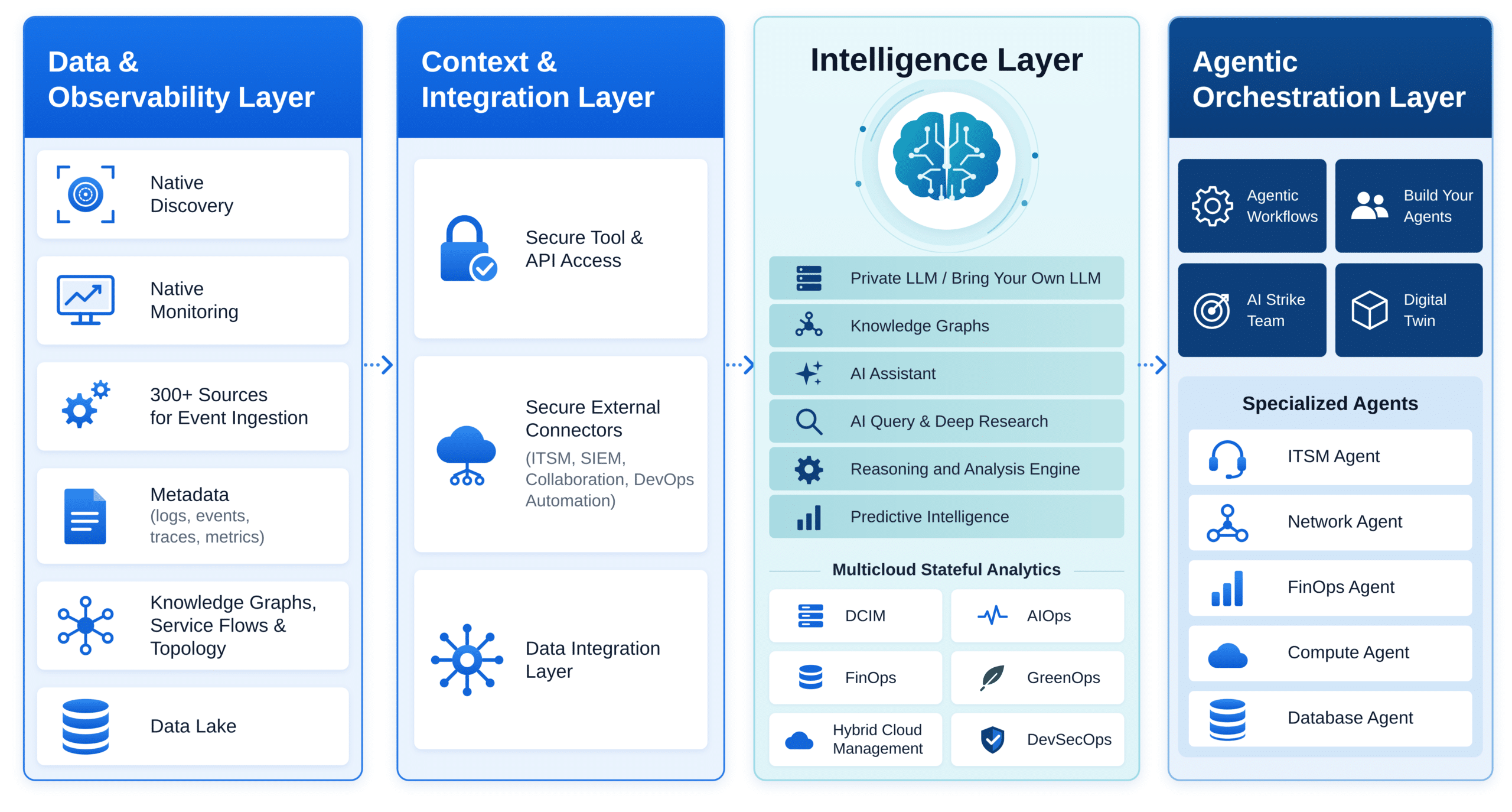
Architecture Overview - How Agents Do Accurate Work for You

The operational sequence was detect → investigate → decide → act → verify. Verification closed the loop by checking results rather than treating a completed action as proof of recovery. Each result also provided an opportunity to learn and improve future operations. Here is how the process begins:
  • Data Ingestion and Observability: Discovery and telemetry establish what exists and what is happening, keeping operational context current.
  • Context and Integration: Topology, dependencies, and enrichment connect signals to the affected infrastructure and services.
  • Intelligence: Reasoning, analysis, and language models support investigation and action planning.
  • Agentic Orchestration: Stateful agents retain context across workflow steps and execute authorized actions, with human approval where required.
Note that teams can use no-code/low-code Agent Builder from UnityOne AI to create custom agents and workflows or deploy from a pre-built suite of specialized agents, including ITSM, Network, FinOps, Compute, and Database, else utilize pre-built workflow templates. Since the Agent Builder integrates atop existing IT environment, teams can extend their current infrastructure without rip-and-replace.
The built-in GenAI conversational interface also supports workflow creation and agent launching. Operators can alternatively use it for root-cause analysis or next-best-action recommendations, without delegating execution.

Breadth Beyond Silos

CERNE’s five operational pillars provided hybrid and multicloud management capabilities, while integrated AI helped teams understand, prioritize, and execute operational work more efficiently.
Data Center Infrastructure Management (DCIM): Asset discovery and inventory, rack and cabinet visualization, connectivity mapping, capacity planning, power monitoring, environmental monitoring, and asset lifecycle visibility provided control over physical infrastructure. AI added natural-language investigation, capacity forecasting, optimization recommendations, and agents that performed delegated operational tasks, with human approval where required.
AI for IT Operations (AIOps): Full-stack observability, infrastructure monitoring, event correlation, noise reduction, anomaly detection, root-cause analysis, and remediation supported service health. Integrated AI connected signals with topology and dependencies to identify probable causes, while agents coordinated remediation and validated whether actions resolved issues.
Hybrid Cloud Management Platform (HCMP): Unified discovery, cloud and Kubernetes management, self-service catalogs, provisioning, configuration, scaling, patching, lifecycle management, and policy enforcement supported consistent operations across environments. Conversational AI simplified access to services and operational context, while agents coordinated provisioning, configuration, and remediation through governed workflows.
FinOps: Cost visibility and modeling, allocation, showback and chargeback, budgeting, forecasting, spend-anomaly detection, and rightsizing supported financial accountability. AI combined cost, utilization, workload, and business context to recommend actions. Authorized workflows could then implement approved optimizations rather than leaving teams with recommendations alone.
GreenOps: Carbon analysis and accounting, power optimization, end-of-life efficiency, and sustainability reporting supported more efficient infrastructure operations. Shared AI capabilities made sustainability information accessible through natural-language interactions and incorporated it into analysis and recommendations alongside capacity, performance, and cost considerations.
The value lays in both functional depth and AI-assisted execution: each pillar fulfilled its management role, while GenAI added conversational access and contextual analysis. Agentic AI carried delegated tasks forward within defined permissions and approval boundaries.

Delegate Authority, Retain Accountability

Delegating work should not mean surrendering authority. CERNE supports workflow-level autonomy, role-based access, policy guardrails, and human-in-the-loop approvals for sensitive changes.
Routine tasks can proceed within approved boundaries; sensitive actions can be routed to human approvers. Centralized tracking records workflow steps, actions, results, exceptions, and approvals, making delegated execution inspectable.

Business Value

CERNE brings these capabilities together to turn cloud management into a more proactive, efficient, and autonomous operating model. By connecting operational intelligence with governed execution, it helps teams reduce manual effort, resolve issues faster, optimize resources, and scale operations without compromising control.
  • Faster resolution: Less manual context gathering between detection, diagnosis, and action.
  • Greater engineering capacity: Fewer repetitive investigations, reports, and operational tasks.
  • Lower management complexity: Consolidated capabilities across functions UnityOne AI positions as replacing 50+ siloed tools, while integrating with retained systems.
  • Better resource efficiency: Coordinated cost, capacity, performance, and sustainability decisions.
  • Controlled automation: Broader delegation with policy alignment, human approvals, and execution visibility.
Agentic Intelligence for Cloud Management takes the next step: enabling teams to delegate operational work to AI agents that understand context, make decisions within defined boundaries, execute authorized actions, and verify outcomes.
With CERNE, UnityOne AI brings this model to hybrid and multicloud operations – combining the breadth of cloud management with the intelligence and autonomy to get work done. The goal is not just to manage cloud infrastructure better, but to enable teams to operate it with greater autonomy, efficiency, and accountability.
Discover how CERNE brings agentic intelligence to your cloud operations.

Ready to Automate Cloud Operations with Agentic Intelligence?

Ready to get started? 

Talk to an expert.

Technical Support

Available 24/7 to assist you with your queries.

Playground

Experience UnityOne AI in action.

About UnityOne AI ™

UnityOne AI™ is an agentic intelligence platform for ITOps management, comprising CERNE™, LUMI™, and VEKTOR™. CERNE™ replaces dozens of cloud management tools by unifying DCIM, AIOps, HCMP, FinOps, and GreenOps within a single AI-driven control plane. LUMI™, the AI copilot, provides contextual intelligence, operational recommendations, and workflow automation, while VEKTOR™ enables enterprises to provision, orchestrate, and scale AI factories with the lowest cost-to-serve. The UnityOne AI™ suite enables enterprises to simplify hybrid/multicloud operations, strengthen governance, optimize resource utilization, and accelerate transformation to AI-driven ITOps.

Copyright © 2026 • All Rights Reserved