UnityOne AI DCIM Vs Traditional DCIM: Managing Hybrid Infrastructure In 2026
UnityOne AI DCIM Vs Traditional DCIM: Managing Hybrid Infrastructure In 2026
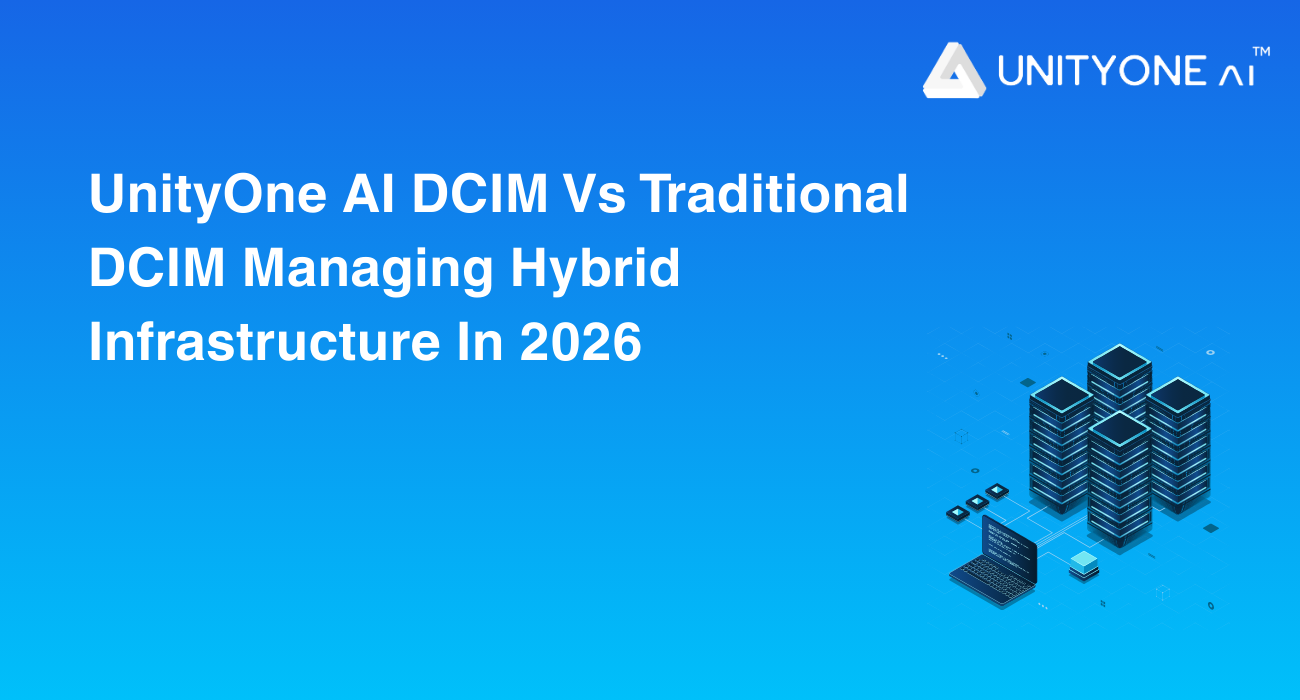
By 2026, hybrid infrastructure will become the backbone of enterprise IT. Organizations are no longer operating in isolated data centers alone; workloads span on-prem facilities, multiple public and private clouds, edge locations, and high-density AI clusters.
This architectural evolution brings agility and scale but also complexity. Managing such environments requires more than traditional monitoring tools. Legacy DCIM systems, once adequate for simple, static infrastructure, are now proving too slow, fragmented, and reactive for the demands of hybrid operations.
UnityOne AI’s DCIM stands out by addressing hybrid complexity head-on. Instead of simply monitoring infrastructure, it delivers predictive intelligence, intelligent automation, and continuous optimization capabilities legacy platforms cannot match in 2026.
The Hybrid Challenge: Why Legacy DCIM Falls Short
Hybrid environments introduce complexity by design. Infrastructure assets are distributed across physical data centers, cloud platforms, and edge locations, each generating different telemetry and operating under different constraints. Legacy DCIM tools struggle to create a unified operational picture across this fragmented landscape.
Most traditional platforms depend on siloed data sources and manual updates. Power, cooling, compute, and network metrics often live in separate systems, forcing teams to reconcile information manually. Asset inventories quickly become outdated as cloud and edge resources spin up and down dynamically.
The absence of real-time intelligence compounds the issue. Legacy DCIM tools rely on static thresholds and reactive alerts that surface problems only after services are already impacted. Without automated discovery or predictive analytics, organizations are left with blind spots, operational friction, and an elevated risk of downtime, especially in environments running AI and mission-critical workloads.
The Next-Gen DCIM Revolution: Key Innovations Driving Proactive Management
The evolution of DCIM mirrors the evolution of infrastructure itself. Modern DCIM platforms are no longer passive documentation tools; they are intelligent systems built for continuous change.
Next-generation DCIM operates on real-time telemetry collected across power, cooling, compute, network, and environmental layers. Instead of isolated metrics, it builds a living operational model of the entire infrastructure.
Artificial intelligence fundamentally changes how this data is used. Machine learning models detect anomalies, forecast failures, and identify inefficiencies by analyzing patterns at scale. Automated remediation replaces manual intervention, allowing proactive operations rather than constant firefighting.
Cloud-native architecture ensures that DCIM itself scales seamlessly across hybrid and edge environments. These capabilities define what DCIM must be in 2026 and highlight why legacy platforms can no longer compete.
UnityOne AI DCIM: A Unified Hybrid Solution
UnityOne AI DCIM brings the principles of next-generation DCIM into a single, cohesive platform designed specifically for hybrid environments. It unifies visibility, intelligence, and automation across on-premises, cloud, and edge infrastructure.
1. Seamless Hybrid Integration Without Silos
UnityOne AI DCIM continuously discovers and maps infrastructure assets across hybrid environments. Servers, storage systems, PDUs, network devices, and environmental components are identified automatically without manual input. This ensures that inventories remain accurate even as infrastructure changes rapidly.
All operational data is consolidated into a single dashboard, providing consistent visibility across power, cooling, capacity, and performance. Fragmented views and manual reconciliation hallmarks of legacy DCIM are eliminated. Teams operate from one trusted source of truth which supports faster and more confident decision-making.
2. Predictive Intelligence That Prevents Downtime
Visibility becomes powerful when paired with intelligence. DCIM powered by UnityOne AI applies machine learning to analyze hybrid data streams in real time, identifying patterns that signal future performance issues or failures.
Instead of reacting to alerts after thresholds are breached, organizations can forecast problems before they impact services. Workload forecasting helps in proactive capacity planning, ensuring resources are available for AI, and high-density workloads when demand increases. This predictive approach can reduce downtime by up to 30% in hybrid environments.
By shifting from reactive monitoring to predictive operations, UnityOne AI DCIM addresses one of the most critical weaknesses of legacy DCIM tools.
3. Intelligent Automation That Scales with Demand
Prediction alone is not enough in complex hybrid environments. UnityOne AI DCIM completes the operational loop through intelligent automation.
Automated workflows respond to real-time insights by balancing workloads, adjusting energy consumption, and initiating remediation without human intervention. Cooling systems adapt dynamically, power usage is optimized, and resources are allocated where they are needed most.
Sustainability becomes an operational outcome rather than a reporting exercise. UnityOne AI DCIM tracks metrics such as Power Usage Effectiveness (PUE) and carbon emissions in real time, aligning infrastructure operations with ESG goals. For AI-driven and high-density environments, this automation ensures performance, efficiency, and sustainability scale together.
To learn more about how UnityOne AI DCIM supports modern data center operations, click on this link.
UnityOne AI DCIM vs Legacy Tools: A Clear Hybrid Advantage
The difference between UnityOne AI DCIM and legacy tools becomes obvious when comparing how each handles hybrid complexity.
| Capability | Legacy DCIM Tools | UnityOne AI DCIM |
|---|---|---|
| Hybrid visibility | Fragmented, siloed views | Fragmented, siloed views |
| Asset discovery | Manual or periodic | Continuous, automated discovery |
| Monitoring approach | Reactive thresholds | AI-driven predictive analytics |
| Downtime prevention | After-the-fact alerts | Failure prediction before impact |
| Scalability | Hardware-bound | Cloud-native, hybrid-ready |
| Sustainability tracking | Limited or manual | Real-time PUE & ESG analytics |
| Automation | Minimal | Policy-driven intelligent workflows |
What This Transformation Means for the Business
The shift to UnityOne AI DCIM delivers measurable outcomes across the organization. Predictive intelligence and automation significantly reduce downtime and operational risk. Unified visibility and real-time insights accelerate decision-making at both operational and executive levels.
Operational expenses decline as inefficiencies are eliminated, and resources are optimized continuously. Capital investments are better aligned with actual demand through accurate capacity forecasting. Sustainability improvements become tangible, supporting regulatory compliance and corporate responsibility initiatives.
Most importantly, organizations gain infrastructure operations that are resilient, adaptable, and future-ready, capable of supporting continued hybrid expansion and emerging workloads without increasing complexity.
Modernizing DCIM is not about replacing everything overnight. It’s about recognizing that DCIM hybrid environments in 2026 require intelligence and automation that legacy DCIM tools were never designed to deliver. As infrastructure becomes more distributed and AI-driven, the operational cost of limited visibility and reactive management continues to grow.
Talk to our UnityOne AI experts to understand how predictive insights and intelligent automation can fit seamlessly into your existing hybrid environment.