UnityOne AI APM: Modernizing Application Performance Monitoring in IT Environments
UnityOne AI APM: Modernizing Application Performance Monitoring in IT Environments
Application performance management has entered a new era.
Modern enterprises run business-critical workloads across hybrid infrastructures that combine private clouds, container platforms, virtualized environments, and AI computing systems. These distributed architectures generate massive volumes of telemetry, including metrics, logs, traces, and resource utilization of data across multiple layers of the technology stack.
Traditional monitoring tools were never designed to handle this level of complexity. They provide fragmented visibility, rely on static thresholds, and struggle to correlate performance issues across interconnected systems. As a result, organizations often detect application failures only after they begin impacting users and business operations.
This growing operational gap is driving the need for intelligent, AI-driven observability platforms. UnityOne AI APM addresses this challenge by combining full-stack visibility, machine-learning-based anomaly detection, automated remediation, and hybrid cloud monitoring into a single unified platform.
Traditional Monitoring Vs Unified Observability
Traditional monitoring systems were designed for static IT environments where applications ran on predictable infrastructure. These tools typically focus on isolated metrics such as CPU usage, memory consumption, and server uptime. Alerts were triggered only when predefined thresholds were exceeded, which meant teams often learned about performance issues after they had already affected users.
Unified observability represents a significant evolution from this model. Instead of analyzing individual metrics in isolation, modern observability platforms correlate telemetry across logs, traces, events, infrastructure dependencies, and application of workflows. This provides contextual insights into how systems interact and how performance issues propagate across environments.
The capabilities outlined below illustrate how UnityOne AI APM brings this shift to life, helping organizations move from basic monitoring to truly intelligent, AI-driven observability.
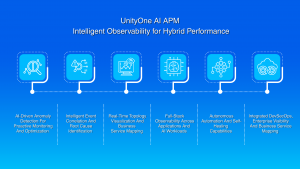
AI-Driven Anomaly Detection For Proactive Monitoring And Optimization
Static thresholds cannot effectively monitor dynamic hybrid environments where workloads scale continuously, and usage patterns fluctuate. UnityOne AI APM uses machine learning algorithms to establish behavioral baselines across applications, infrastructure resources, and GPU workloads.
The system continuously analyzes real-time telemetry to identify deviations that indicate emerging performance risks. It tracks critical indicators such as application response time, uptime, transaction speed, resource utilization, and abnormal performance patterns. By detecting anomalies early, the platform allows IT teams to address issues before they escalate into service disruptions.
AI-driven anomaly detection also improves mean-time-to-detection because it focuses on contextual intelligence rather than isolated metrics. This significantly reduces false alerts while increasing operational accuracy.
The platform also supports threshold-based alerts combined with AI-driven insights, helping prevent outages and optimize resource utilization before performance degradation affects users.
To learn more about AI-Driven Anomaly Detection, read our blog here.
Intelligent Event Correlation And Root Cause Identification
One of the biggest challenges in large enterprise environments is overloading alerts. Thousands of alerts generated from multiple monitoring tools often make it difficult to determine which issues require immediate attention.
UnityOne AI APM uses AI-powered correlation engines to analyze relationships between events across applications, infrastructure, and networks. It correlates metrics, logs, and traces to quickly pinpoint performance bottlenecks and infrastructure-level dependencies. Multicloud AIOps agents collect alerts from automatically group related events into a single contextual incident.
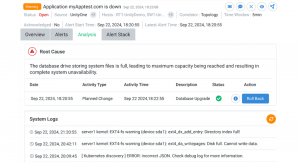
This capability helps in faster root cause analysis by identifying the exact component responsible for performance degradation. Instead of manually investigating multiple dashboards, teams can immediately focus on the underlying cause of an issue.
Real-Time Topology Visualization And Business Service Mapping
Hybrid environments introduce visibility challenges because application dependencies constantly change as workloads migrate or scale. UnityOne AI APM provides dynamic topology visualization that maps relationships across servers, containers, databases, and network components.
Through auto-discovery mechanisms, the platform continuously updates dependency maps to reflect real-time infrastructure changes. Engineers can trace performance issues visually from application layers down to infrastructure components, significantly reducing troubleshooting time and improving operational efficiency
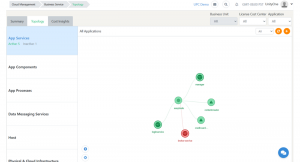
This capability extends into business service mapping by automatically mapping business services to applications, servers, databases, and network components. It provides real-time topology views showing relationships between IT components and business services while identifying affected business services during incidents to allowing faster, priority-driven resolution through impact analysis and prioritization.
Full-Stack Observability Across Applications And AI Workloads
Modern applications rely on distributed architectures that include microservices, APIs, and container platforms. UnityOne AI APM delivers end-to-end distributed tracing that tracks application transactions across every service interaction, including user transactions across microservices, APIs, databases, and third-party integrations for complete execution-flow visibility.
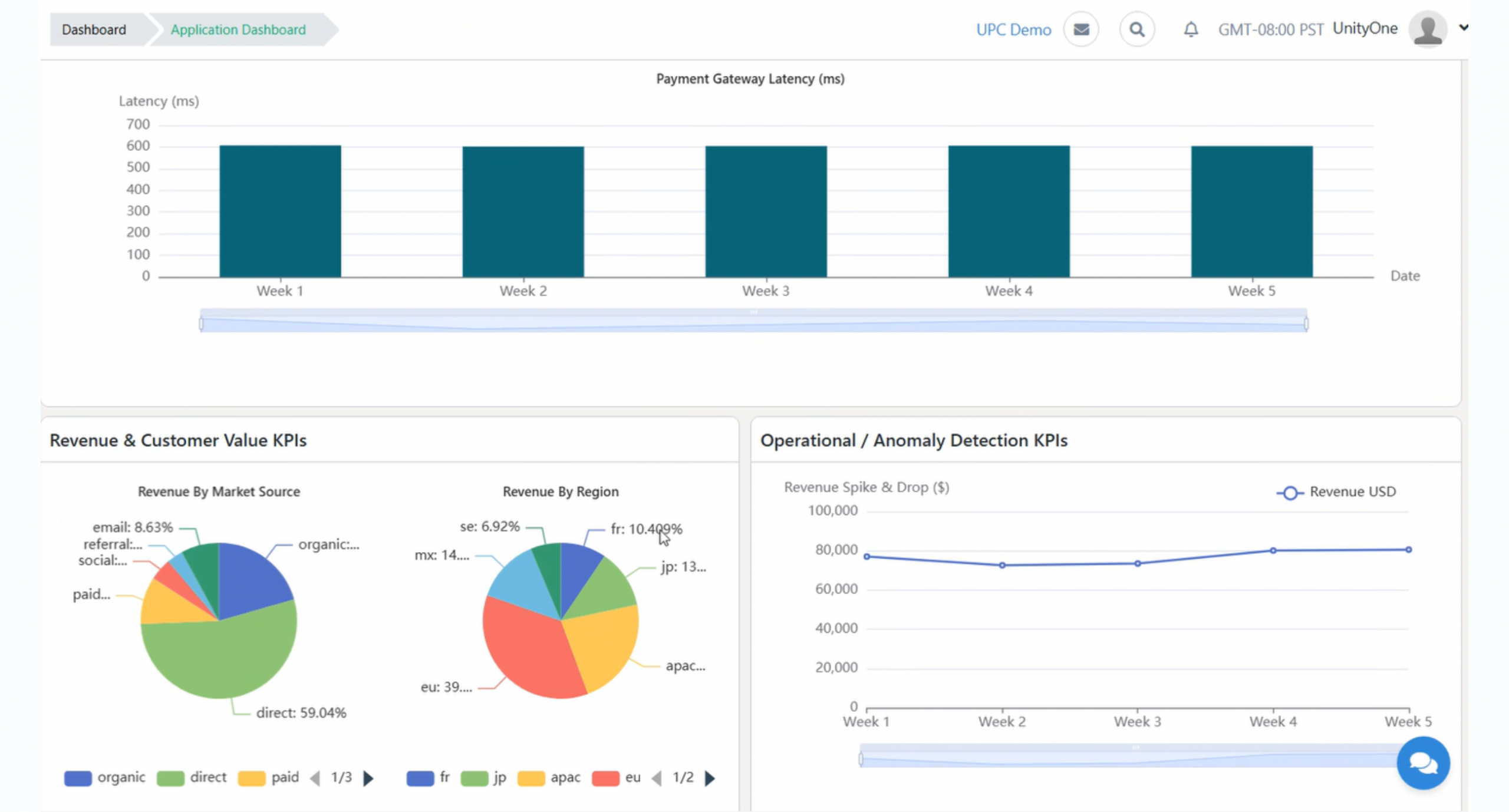
The platform extends observability beyond traditional applications by supporting container monitoring, including Docker environments, and providing visibility into AI workloads by monitoring GPU utilization, latency, throughput, and resource consumption for machine learning and AI inference pipelines.
This holistic approach ensures organizations can optimize both application performance and advanced computing workloads within a single observability framework.
Autonomous Automation And Self-Healing Capabilities
Manual incident resolution becomes increasingly difficult as IT environments grow in scale and complexity. UnityOne AI APM incorporates AI-driven automation that supports proactive remediation workflows.
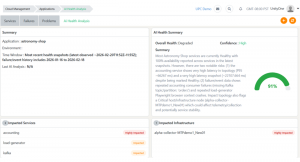
When performance anomalies occur, the platform can automatically execute corrective actions such as scaling resources, redistributing workloads, or restarting affected services. Automation orchestration capabilities allow organizations to streamline routine operational tasks while maintaining system stability.
This self-healing approach reduces downtime, minimizes manual intervention, and ensures continuous service availability while allowing continuous monitoring of application health, response times, throughput, and error rates across on-prem, cloud, and hybrid environments.
Integrated DevSecOps, Enterprise Visibility And Business Service Mapping
Application performance and security are deeply interconnected. UnityOne AI APM integrates DevSecOps capabilities directly into the observability pipeline, enabling vulnerability detection, threat monitoring, and compliance tracking alongside performance analytics.
The platform also integrates seamlessly with IT service management systems, allowing organizations to manage incidents and workflows through unified dashboards. This integration ensures collaboration across operations, security, and development teams.
Driving Business Value Through Intelligent APM
The adoption of AI-powered application performance monitoring delivers measurable business benefits. Organizations can reduce downtime through proactive anomaly detection and automated remediation. Operational efficiency improves as automation minimizes manual troubleshooting tasks.
Unified visibility enhances collaboration across teams, while optimized resource utilization reduces infrastructure costs. Most importantly, improved application performance directly enhances user experience and service reliability.
The Future of Intelligent Application Performance Management
As hybrid environments continue to evolve, the need for intelligent observability will only grow. Organizations require platforms that can interpret vast telemetry data, predict performance risks, and automate operational responses.
UnityOne AI APM represents this next generation of application performance management by combining artificial intelligence, full-stack visibility, and self-healing automation.
Connect with us to learn how UnityOne AI APM can help your organization achieve predictive monitoring, automated remediation, and unified visibility across hybrid and multicloud environments.