Scaling AI Workloads for Dynamic Provisioning with UnityOne AI HCMP
Scaling AI Workloads for Dynamic Provisioning with UnityOne AI HCMP
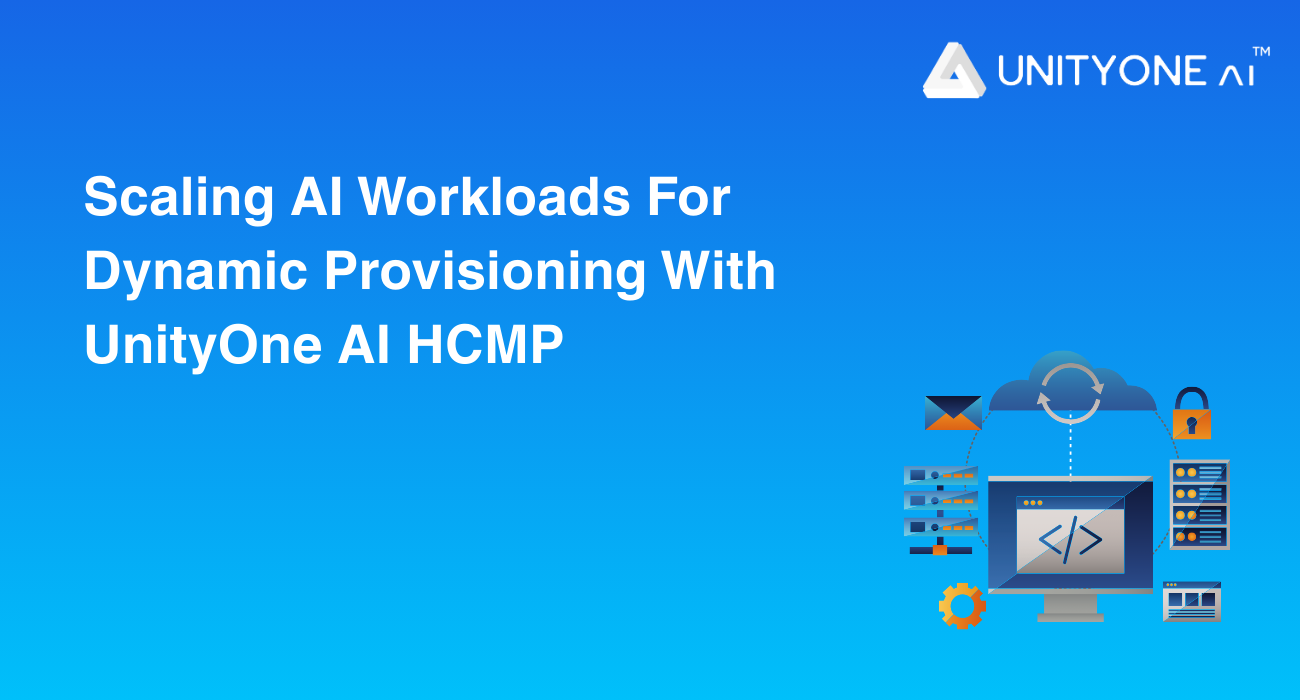
As we move through 2026, Artificial Intelligence has become the operational backbone of enterprises adopting innovation. From real-time decision systems and intelligent automation to predictive analytics and generative applications, AI now drives how organizations compete and grow. This shift has placed unprecedented pressure on infrastructure, exposing the limits of manual provisioning and static capacity models.
Human-driven systems cannot keep pace with the volatile, unpredictable demands of AI workloads. Training jobs, inference services, and data pipelines scale and contract continuously, often within minutes. Infrastructure must now respond in real time, adapt automatically, and scale intelligently without human friction. This is exactly where UnityOne AI HCMP changes the equation.
As an AI-native Hybrid Cloud Management Platform, UnityOne AI helps enterprises to dynamically provision, orchestrate, and scale AI workloads across hybrid and multicloud environments with speed, intelligence, and control. It transforms infrastructure into an adaptive foundation for AI-driven growth.
Why Traditional Models Struggle with Modern AI?
Traditional management models were built for predictable workloads and stable demand patterns. Resources were provisioned in advance; environments changed slowly, and operations relied heavily on manual oversight. These approaches assume that workload behavior can be anticipated and managed through simple autoscaling or reactive intervention.
Modern AI workloads break these assumptions completely. Training jobs consume massive GPU capacity for defined windows and then disappear. Inference services surge instantly based on user behavior. Data pipelines evolve continuously as models are refined. These patterns do not align with static rules or fixed thresholds.
Legacy platforms rely on predefined policies, isolated monitoring, and reactive workflows. They lack awareness of workload intent, GPU suitability, data locality, and cross-environment dependencies. As a result, enterprises face GPU queues, resource contention, idle capacity, and unpredictable cloud spend. AI teams wait for resources; experiments slow down, and production environments become fragile under pressure.
UnityOne AI HCMP: A Unified Brain for Hybrid Clouds
UnityOne AI’s Hybrid Cloud Management Platform is built for hybrid environments where AI workloads are dynamic and resource intensive. At its core, UnityOne AI HCMP provides a single, unified control plane that centralizes visibility, orchestrates automation, and enforces governance across public cloud, private infrastructure, and edge systems.
Through unified multi-cloud discovery and unified multi-cloud management, the platform delivers comprehensive visibility from a single dashboard. Assets, workloads, and dependencies are continuously discovered and mapped in real time, eliminating blind spots and fragmented views across hybrid ecosystems.
As an AI-native platform, UnityOne AI HCMP does more than collect data. It builds a living model of how applications, services, infrastructure, and data flows are interconnected. This interdependency awareness is critical for AI workloads, where performance depends on complex chains of compute, storage, network, and data services.
The Mechanics of Intelligent Dynamic Provisioning
Dynamic provisioning is where UnityOne AI HCMP fundamentally changes how AI workloads are scaled. The platform continuously monitors telemetry across compute, GPU utilization, pipelines, applications, and dependencies. It understands patterns and intent rather than reacting to isolated metrics.
When a training job starts, when an inference service receives increased traffic, or when a pipeline restarts, UnityOne AI HCMP recognizes these events in context. It makes real-time provisioning decisions based on workload intent, resource availability, policy constraints, and performance requirements.
GPU-aware orchestration is central to this process. UnityOne AI understands GPU types, availability, and suitability for specific workloads. It selects optimal resources across on-prem clusters, private cloud, and public cloud environments, avoiding queueing, starvation, and idle waste.
Through policy-driven resource management, allocation and optimization are automated using scripts such as Ansible, Terraform, Bash, and Python. Policies are enforced consistently across environments, ensuring that scale remains controlled and compliant.
Protecting Performance through Predictive AIOps
UnityOne AI HCMP integrates predictive AIOps to identify emerging risks and initiate corrective action early. The platform correlates events, filters noise and surfaces meaningful patterns across hybrid environments.
It detects developing bottlenecks, misconfigurations, OS vulnerabilities, and degradation trends. Through OS vulnerability and compliance monitoring, the platform automatically detects, prioritizes, and recommends remediation actions.
When an issue is identified, UnityOne AI triggers remediation workflows using its DevOps automation and orchestration engine. Predefined tasks using Python, Ansible,etc. are executed securely with role-based access control, maintaining consistent service performance as demand shifts.
Synchronizing Scale with Financial and Green Governance
UnityOne AI HCMP embeds cost optimization, policy enforcement, and sustainability awareness into its orchestration engine. Idle resources are identified and reclaimed, capacity is rightsized, and workloads are placed efficiently across environments.
Through its self-service catalog, users can rapidly provision tasks such as VM provisioning, backup configuration, firewall management, and server setup, all governed by role-based access control and approval of workflows. Optimized placement and utilization also support GreenOps initiatives by reducing energy consumption and carbon footprint.
Moving Beyond Management to Autonomous Orchestration
UnityOne AI HCMP represents a shift from infrastructure management to autonomous orchestration. Through Gen AI driven workflow orchestration, users can describe their goal, and the platform understands intent, suggests tasks, and auto-generates workflows. AI-driven components adapt based on context and act independently.
Kubernetes and microservices management are deeply integrated, providing real-time monitoring, optimization, and auto-healing across clusters. Containers, virtual machines, and hybrid applications are orchestrated through a single intelligent model.
The Foundation of the Autonomous Enterprise
The demands of modern AI workloads have exposed the limits of traditional hybrid cloud management. Static scaling, siloed visibility, and manual provisioning no longer support AI-driven business models.
UnityOne AI’s Hybrid Cloud Management Platform answers this challenge with an AI-native orchestration layer designed for unified multi-cloud discovery, intelligent dynamic provisioning, predictive AIOps, and governed scale. It transforms hybrid infrastructure into an intelligent system that learns, anticipates, and acts.
Talk to our experts and learn how UnityOne AI HCMP supports intelligent, governed scaling for AI workloads.