UnityOne AI™ Automation Workflows: High-Reliability Execution Across Azure Environments
UnityOne AI™ Automation Workflows: High-Reliability Execution Across Azure Environments
As Azure environments grow in complexity, enterprises are demanding automation frameworks that offer deterministic execution, idempotent workflows, consistent state management, and cross-layer orchestration.
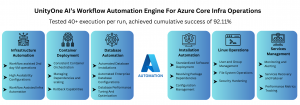
UnityOne AITM’s Workflow Automation engine was evaluated across a broad set of Azure operational scenarios, with each use case executed more than 40 times to simulate real-world conditions such as dependency variations, network fluctuations, and service latency.
Our platform delivered a 92.11% cumulative success rate, validating its architecture as suitable for high-scale cloud operations, multi-stage provisioning, and autonomous remediation pipelines. The results reflect not only workflow stability but also the maturity of UnityOne AITM’s connectors, execution engine, and policy-driven orchestration capabilities across Azure.
1. Azure IaaS Automation: Deterministic Provisioning and Lifecycle State Consistency
UnityOne AI™ demonstrated high execution fidelity across Azure IaaS operations, ensuring workload consistency, repeatable automation, and minimal configuration drift.
Key technical workflows executed:
- Automated provisioning pipelines for Windows and Linux VMs using hardened, policy-tested templates
- VM start/stop orchestration with policy-based scheduling, state reconciliation, and post-action validation
- Disk attach/detach automation with dependency mapping, integrity verification, and safe-detach sequencing
- Snapshot workflows with embedded backup-policy checks, metadata preservation, and asset lineage tracking
- Tag enforcement pipelines ensuring compliance alignment, inventory accuracy, and granular FinOps visibility
What makes this important?
Because provisioning issues disrupt deployments, delay releases, and introduce configuration drift.
UnityOne AI™'s results prove that it can orchestrate Azure infrastructure with:
- Zero human intervention during the full lifecycle
- Golden-image VM deployments built from immutable and validated templates
- Deterministic repeatability across dozens of provisioning and teardown cycles
For enterprises, it translates to faster environments, fewer tickets, and consistent governance across large Azure estates.
2. Container Deployments: Idempotent Orchestration and Dependency-Aware Execution
Containerized workloads introduce orchestration complexity due to package inter-dependencies, image versioning, environmental drift, and inconsistent network-repository availability. UnityOne AI™ neutralizes these variables through strict idempotency controls, pre-flight dependency validation, and deterministic execution logic—ensuring container rollouts behave predictably across distributed Azure environments and diverse Linux baselines.
Key technical workflows executed:
- Docker Engine installation with full dependency-graph resolution and OS-package compatibility checks
- Automated container deployments backed by environment consistency validation and runtime state verification
- Apache2/Nginx workload layering with deterministic sequencing and service readiness probes
- Pre-deployment package verification including registry accessibility and image version checks
- Execution logic aligned to orchestration best practices ensuring state convergence and rollback-safe actions
In an era where microservices drive enterprise apps, UnityOne AI™ ensures container automation behaves the same way — every time, on every run.
3. Database Automation: Streamlining High-Risk, High-Impact Workflows
Database provisioning and application-linked DB workflows are among the most sensitive components in any environment due to their dependency chains and operational risk. UnityOne's performance in this category showcases a workflow engine capable of maintaining transactional consistency, enforcing configuration integrity, and orchestrating multi-service dependencies with precision. The result: minimized operational risk, reduced downtime windows, and significantly accelerated deployment cycles across Azure-backed application stacks.
Key technical workflows executed:
- Database-linked application deployments with strict dependency ordering, schema readiness checks, and connection validation
- Environment provisioning pipelines using configuration file templating, state validation, and parameterized inputs to prevent drift
- Multi-service orchestration ensuring DB services, application layers, and supporting microservices reach operational readiness in the correct sequence
- Version-controlled workflow executions guaranteeing deterministic behavior and repeatability across multiple deployment cycles
With this level of control, observability, and deterministic execution, enterprise DB automation becomes not only safer — but reliably scalable, compliant, and cloud-optimized.
4. Installation Automation: Standardized Package Deployment
Package installation across Linux-based environments is often a source of inconsistency due to repository variability, dependency drift, and OS-level heterogeneity. UnityOne AI™'s installation automation workflows deliver deterministic, validation-first execution that standardizes builds across distributed Azure environments, golden images, and CI/CD-driven deployment pipelines. Every installation is treated as an atomic, auditable operation—ensuring no partial states, no configuration skew, and no surprises downstream.
Key technical workflows executed:
- Automated installation of Apache2, Nginx, and Docker Engine using dependency mapping, version checks, and OS compatibility validation
- System package installation pipelines that validate repository health, package signatures, and dependency availability before execution
- Failure-triggered rollback logic ensuring installations revert cleanly to the last known good state without leaving orphaned configs
- Configuration checksum validation to guarantee post-installation state integrity and prevent silent drift
For cloud engineering and DevOps teams, this translates into predictable environment builds, uniform application stacks, and fully automated remediation—eliminating the manual troubleshooting and configuration mismatches that traditionally slow down deployments across large-scale Azure ecosystems.
5. Linux Operations: Automated OS-Level Governance and Policy Enforcement
Linux operations underpin the reliability and security posture of every enterprise cloud environment. UnityOne AI™ delivered high-precision execution across OS-level workflows by enforcing policy-driven baselines, validating system state before and after each operation, and eliminating configuration drift through deterministic orchestration. Its automation engine treats Linux governance as a continuous, enforceable discipline—ensuring consistency across distributed Azure workloads, edge nodes, and hybrid infrastructure.
Key technical workflows executed:
- Automated user creation and permission enforcement with audit-ready logging, policy inheritance, and privilege validation
- Patch orchestration pipelines ensuring secure OS baselines, dependency validation, and reboot-governance controls
- Service restarts backed by dependency mapping, process health monitoring, and post-restart state checks
- Cron job automation with conflict detection, schedule validation, and lifecycle tracking
- OS configuration enforcement aligned to compliance baselines (CIS, internal policy frameworks, and workload-specific requirements)
These outcomes highlight UnityOne AI™'s ability to enforce compliance and eliminate human error at infrastructure scale.
Final Thought: Automation You Can Trust Across Every Layer of Azure
From VM provisioning and container orchestration to database deployment, patching, and service governance, UnityOne AI™ proves that automation can be both powerful and dependable.
The 92.11% success rate is not just an operational metric:
It is a strategic advantage. It represents fewer escalations, fewer deployment delays, lower operational overhead, and a significantly more predictable environment across the Azure ecosystem.
For CIOs and CTOs shaping the next phase of cloud maturity, UnityOne AI™ offers:
- Operational resilience through deterministic automation
- Faster delivery across infrastructure, application, and data layers
- Reduced cost-to-operate with automated governance and remediation
- Consistent compliance across global, distributed cloud estates
- A pathway to autonomous operations powered by smart workflows
Explore how UnityOne AI™ enables intelligent, repeatable, and resilient Azure automation—giving your teams the confidence to scale safely and efficiently.